
Seeing the Unseen: The Beauty of Geometry in Everyday Design
I’ve always been fascinated by how geometry in everyday design quietly shapes our world. It’s everywhere, in architecture, art, technology, and even the objects we hold. When I first studied design, I realized that hidden geometry guides how we see, build, and feel without us even noticing.
Exploring the Hidden Geometry in Our World and Everyday Life
Every day, I walk through spaces that feel “right.” That feeling comes from mathematical principles like proportions, balance, and harmony. These are not just visual choices; they’re based on geometric concepts that create aesthetic sensibilities and visual interest.
The golden ratio and Fibonacci sequence often appear in everyday objects. Ancient builders in ancient Greece used the Parthenon as an example of aesthetically pleasing balance. Today, tech companies like Apple still rely on the same mathematical constant to craft logos, user interfaces, and functional designs that feel naturally harmonious.
In my own work, I’ve used these ideas when designing rooms, choosing furniture, or laying out web design. Even packaging like credit cards and cereal boxes follows these natural proportions, making them instantly appealing. It’s subtle but powerful; we respond to visual consistency almost subconsciously.
Geometry in Everyday Objects
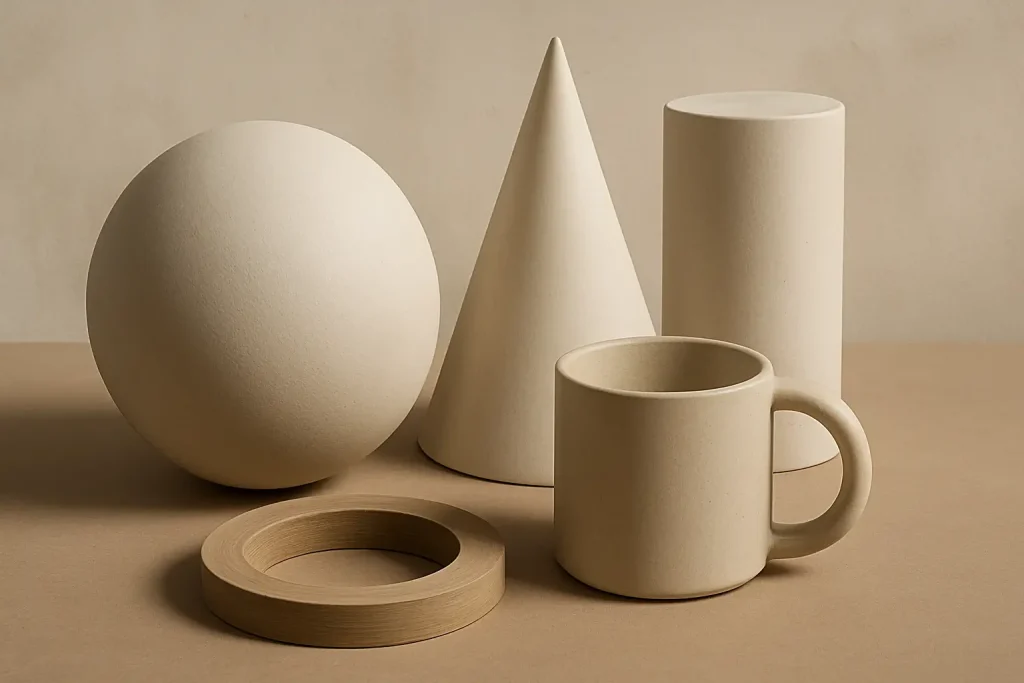
I once designed a small exhibit about how shapes define daily life. That project opened my eyes to the geometry in everyday design. The sphere, cone, and cylinder became my foundation, three perfect examples of how form meets function.
The Sphere – Perfection in Symmetry
Spheres in Nature
Nature loves symmetry. Planets, stars, and even raindrops take on spherical symmetry because of gravity and surface tension. This shape distributes force equally, showing nature’s efficiency. Cells and microscopic organisms follow this same rule, minimizing surface area to volume for better energy conservation.
Spheres in Everyday Life
Look around, sports rely on spheres. Balls in soccer, basketball, and tennis depend on perfect balance and motion. In technology, light bulbs and microphones use spherical geometry for smooth sound and light distribution. Even food like apples or ice cream scoops reflects functional beauty.
The Symbolism of the Sphere
To me, the sphere represents wholeness and continuity. Many ancient civilizations saw it as the perfect form. Modern artists and designers still use it as a symbol of unity and infinity.
The Cone – Tapered Precision
Cones in Nature
The cone directs energy. Volcanoes form through eruptions, creating natural conical structures that manage flow and strength. Pinecones and flowers use this form to capture sunlight and ensure reproduction.
Cones in Human Design
In daily life, the cone serves both beauty and functionality. Traffic cones keep roads safe through visibility and stability. Ice cream cones show how geometry meets practicality, using less material yet holding more. Tools like funnels or megaphones use this shape to direct liquid or sound efficiently.
The Symbolism of the Cone
The cone suggests aspiration and focus. From temples and spires to ceremonial hats, it always points upward, connecting formality and mysticism.
The Cylinder – Balance and Functionality
Cylinders in Nature
Tree trunks, bamboo, and reeds show how nature uses the cylinder for strength and flexibility. In animal anatomy, bones and shells adopt cylindrical forms to stay light yet stable.
Cylinders in Human Life
We rely on cylinders, containers, water bottles, wheels, and columns. This shape ensures smooth motion and durability. Classical architecture, like Greek columns, uses cylindrical symmetry to create harmony and strength.
The Symbolism of the Cylinder
The cylinder represents continuity, flow, and persistence. In both natural contexts and artificial design, it feels indispensable.
Hidden Interactions: When Spheres, Cones, and Cylinders Work Together
What fascinates me most about geometry in everyday design is how these shapes combine. A coffee cup is a cylinder, but its rounded bottom hints at a sphere, and its tapering inside echoes a cone.
In architecture, you’ll find domes, pillars, and spires merging to form breathtaking structures. In engineering, engines use cylinders, spherical bearings, and cones to manage motion and energy flow. These interactions define efficiency and beauty in both design and engineering.
Geometry in Urban Planning and Architecture
When I travel, I often admire how urban planning uses geometry to create livable cities. Every layout, street, and green space follows geometric planning for movement and balance.
Buildings like the Eiffel Tower, Taj Mahal, or Islamic architecture show geometric precision. They combine structure, formality, and symmetry to achieve both functionality and artistry.
Even modern architecture, from Apple Store layouts to city grids, follows the same principles, proving how deeply geometry in everyday design shapes our surroundings.
Geometry in Nature and Art
The Artistry of Nature: Geometry in the Natural World
Whenever I see a honeycomb, snowflake, or nautilus shell, I’m reminded that nature is the original designer. Its hexagonal cells and spirals reveal mathematical precision that we still mimic in modern design.
The Path Less Travelled: Geometry in Art and Creativity
Artists like Pablo Picasso and M.C. Escher explored geometric shapes, depth, and perspective to evoke emotion. Their art theory and composition influenced how I think about creativity, structure, and freedom coexisting. Even cubist paintings and optical illusions show geometry in everyday design from a new dimension.
Geometry in Technology and Innovation
I’ve worked on digital design projects where geometry is everywhere. From pixels on a screen to 3D models, everything depends on geometric algorithms.
Computer graphics and virtual reality rely on mathematical precision to create intuitive experiences. Tech platforms, social media feeds, and engineering software all depend on this hidden geometry to stay efficient and visually appealing.
This digital innovation proves that even our virtual world is built on ancient principles of geometry in everyday design.
Geometry in Innovation and Sustainability
Geometry also drives sustainable design. When I worked on an environmental science project, I saw how geometry helps optimize renewable energy systems and waste management.
Architects use mathematical principles to reduce materials while improving quality and efficiency. Geometric planning supports urbanization without harming natural balance, offering real solutions for our planet’s future.
Geometry Beyond the Surface: Scientific Applications
Physics and Engineering
In engineering, aerodynamics and acoustics use conical and cylindrical shapes to control flow and sound. Rockets, trumpets, and MRI scanners all depend on precise geometry for strength, resilience, and functionality.
I remember touring an aerospace lab, seeing how fractal structures and computational models mimic natural patterns to improve performance. Science uses geometry in everyday design more than we realize.
Geometry in Culture and Design
Across cultures, geometry has always been a symbol of unity and beauty. Greek columns, Gothic spires, and minimalist architecture all prove that form can express meaning.
Even in product design, shapes like globes, crystal balls, and cones express completeness and focus. This connection between culture, art, and geometry keeps design both universal and emotional.
Why We Overlook the Geometry Around Us
Most people move through ordinary life without noticing the geometry shaping it. We see objects, but not their structure or function.
When I explain geometry in everyday design to my students, I ask them to look again at a soda can, a spire, or a ball. Once you notice it, you can’t unsee it. That’s when appreciation begins — for visible and invisible connections between art, science, and the natural world.
Related FAQs
Why is geometry important in everyday design?
It connects functionality, beauty, and efficiency in everything from buildings to digital design.
How do designers use geometric shapes in real products?
They use symmetry, proportions, and patterns to create balance and aesthetic harmony.
What are examples of geometry in everyday life?
Look at architecture, packaging, sports, nature, and even tech interfaces.
How does nature influence geometric design?
Nature-inspired patterns like spirals and honeycombs inspire designers to create sustainable, functional designs.