
Surface Area Estimation Mistakes You Should Never Make Again
I’ve seen even smart students struggle with surface area estimation mistakes. It’s rarely about math skills, it’s about missing details that change everything. When I started teaching geometry, I noticed how small misunderstandings of shape, measurement, and units lead to big errors. The goal isn’t just to calculate numbers, it’s to understand what those numbers mean in real-world designs and 3D problems.
Surface area is more than a topic in math; it’s the foundation of engineering, architecture, and design accuracy. If your formulas, measurements, or units are off, your whole calculation collapses. Let’s explore the common mistakes people make while estimating and how to avoid them confidently.
Using Incorrect Units of Measurement
This is the first and most frequent cause of surface area estimation mistakes. I’ve seen learners forget to match units, mixing inches with centimeters or square units like cm² and in². That small mismatch creates massive errors.
Always work in consistent units before beginning your calculation. Whether you use the metric system or imperial system, choose one and stick with it. If your figure has dimensions in different units, convert them all into the same measurement system.
Another habit that helps is labeling every side, length, width, and height clearly. When I review student work, missing labels and measurements usually lead to wrong answers. Consistency builds accuracy, especially when determining the total surface area of 3-dimensional figures like cube, prism, or cuboid.
Failing to Account for Additional Areas or Exclusions
Here’s where people often lose marks. Many forget to include all surfaces or wrongly add hidden ones. For instance, when estimating the area of composite shapes, some miss joined surfaces or exposed surfaces.
In a rectangular solid, every face has an opposite face, making six in total. Forgetting one pair or double-counting another causes incorrect answers. I once watched a student skip the flat circular base of a hemisphere that small oversight reduced the accuracy of the entire calculation.
Always break composite shapes into individual components. Compute each face area, then combine them logically. For composite figures like a cylinder attached to a hemisphere, exclude the joined surfaces that aren’t visible. Only calculate exterior surfaces that form the outer surface of the object.
This kind of detailed problem-solving may seem slow, but it improves clarity and prevents wasted effort in revision.
Relying on Rough Estimates
“Close enough” isn’t good enough in surface area estimation mistakes. I learned this while helping children prepare for examinations, rough estimates destroy accuracy. Using rough estimates instead of precise formulas or measurements leads to inconsistent results and failed evaluation.
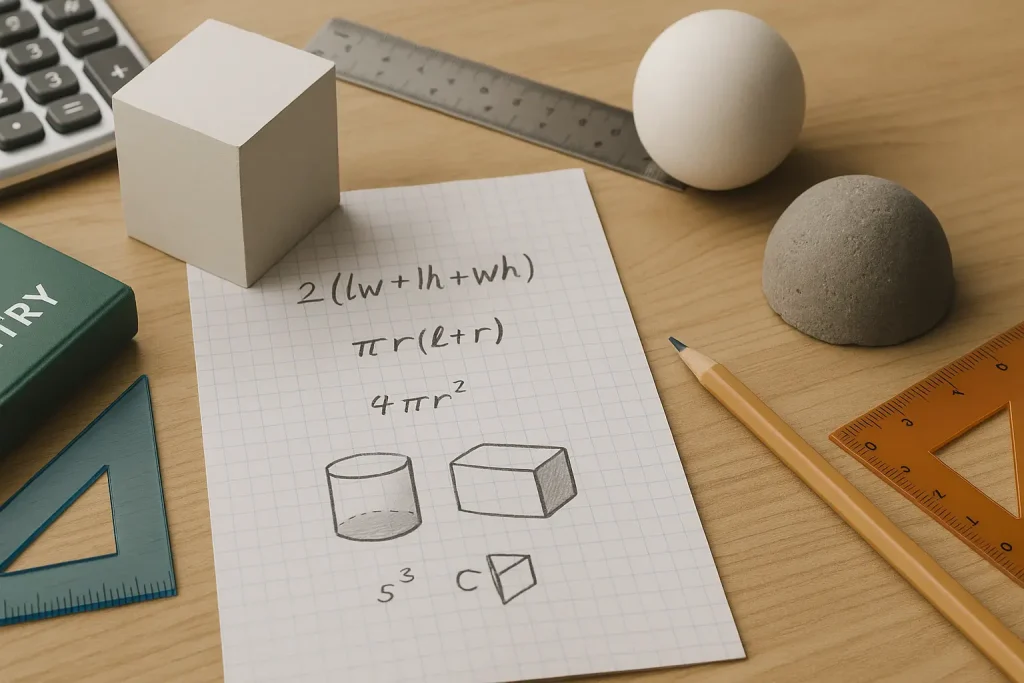
Surface area depends on exact dimensions, not guesses. The formulas like 2(lw + wh + lh) for cuboid or lateral surface area formula 2h(l + w), require precise values of length, width, and height. When people skip terms or round too early, logical errors multiply.
In my own practice, I recommend writing the structured formula first, substituting numbers carefully, and double-checking each step. This reduces computational errors and boosts performance. Remember, even one skipped term changes the magnitude of your result.
Neglecting Irregular Shapes
Not every geometric figure fits neat formulas. Ignoring irregular shapes is one of the biggest surface area estimation mistakes I’ve seen. Many learners stick to cube or rectangular solids, avoiding composite or irregular designs because they seem complex.
But in real-world math and structural geometry, irregular forms appear everywhere from hemispheres and cones to architectural models and industrial design. To handle these, learn to differentiate faces, curved surfaces, and planes. Label them before you calculate.
For example, in a cone, the slant height replaces the perpendicular height in the formula. If you confuse these, your answers fail accuracy checks. Similarly, the total surface area of a hemisphere includes both the curved surface and the flat circular base. Forget one, and your measurement fails.
When I teach this, I tell students to draw figures and interpret what’s visible. Visual understanding makes geometry simple. The goal is not just memorization it’s conceptual clarity.
Forgetting to Adjust for Sloped Surfaces
Many students ignore sloped surfaces in surface area estimation mistakes. These are tricky because they change the area without changing the shape dimensions much. For example, a roof or cone has slanted planes that need their own formulas.
The formula accuracy depends on recognizing slant height instead of perpendicular height. I’ve seen people use length and width instead of true height, giving incorrect formulas and wrong answers.
Here’s a tip I share in math education workshops, draw a cross-section to see which sides are parallel and which are sloped. That helps you determine the total area properly.
In real-world applications, like designing a roof structure or curved surface in architecture, ignoring sloped dimensions can ruin calculations and increase costs.
Not Double-Checking the Calculation
This is where even professionals slip up. They know the formulas but skip the final verification step. Every accurate surface area estimation demands one final double-checking phase.
In my classroom learning, I make students verify results by recalculating using another method or unit system. If both match, the calculation is correct. This step ensures accuracy, consistency, and logical process.
When reviewing examination marks, I’ve noticed that students who cross-check always score higher. Double-checking identifies quantitative mistakes, misinterpretations, and even wrong applications of formulas.
A good practice is to reverse the formula mentally, like verifying the volume with given surface area to ensure consistency. This habit shows deep understanding and strong command of mathematical reasoning.
Related FAQs
Why is it important to use correct units when calculating surface area?
Because the measurement system defines your accuracy. Mixing centimeters, inches, or square units changes the result entirely. Consistent units are vital for reliable surface area estimation.
How do I handle irregular shapes when estimating surface area?
Break irregular shapes into smaller components. Use correct formulas for each part and add their areas to get accurate calculation results.
What are common signs of incorrect surface area calculations?
If answers differ by large magnitude or don’t match visual understanding, you likely made formula, unit, or measurement errors.
How can I avoid rounding or estimation errors in surface area measurement?
Always keep values precise. Avoid early rounding and follow each calculation step carefully. Verify results and maintain consistency.
Why should sloped or curved surfaces be considered in area estimation?
Because curved or sloped surfaces contribute to the total surface area. Ignoring them leads to incorrect answers and structural inaccuracy.